For parents of high school juniors and seniors

Your teen doesn't need to know what they want to do yet. They need a way to find out.

The SPARK Workbook walks your teen through five steps to find 3 paths worth exploring (college, trade or career) and test each one in the real world before anyone spends a dollar on tuition.

Yes, give my teen a way to find out
🔒 Secure checkoutInstant downloadPrint at home
Photo: teen trying real work
A teenager learning the ropes from a shop owner at a clothing store

The question that ends the conversation

"So, what are you thinking about after graduation?"

You know how this goes. A shrug. "I don't know." A sudden interest in their phone. And the conversation is over until the next time someone asks at a family dinner.

Meanwhile the calendar keeps moving. Applications, deadlines, financial aid forms, a counselor meeting, and a relative who's sure your kid should be an engineer.

Your teen is being asked to make one of the biggest decisions of their life, usually before they've had the chance to try much of anything.

Not knowing isn't the problem.

Photo: parent and teen talking
A family talking together in their living room

Quiz, guess and hope

Most families are handed two tools.

The first is the career quiz. Your teen answers 40 questions and gets a label: "You'd make a great accountant." Maybe. But there's no way to find out short of becoming one.

The second is the default: "Go to college. You'll figure it out there." Sometimes that works. Sometimes it means a year or two of expensive figuring out. About 1 in 3 bachelor's degree students change their major within their first three years.1 And one semester of tuition and fees alone runs roughly $6,000 to $23,000, depending on the school.2

Both skip the one step that actually produces clarity: trying things. And both quietly push aside some excellent options. Electricians, nurses, IT technicians, welders and dental hygienists build real careers through certificates and apprenticeships that rarely get a fair look at the kitchen table.

This isn't your teen's fault, and it isn't yours. Nobody handed either of you a method.

Guessing is the expensive part.

Sources: 1. National Center for Education Statistics, Beginning College Students Who Change Their Majors (2017). 2. Education Data Initiative, Average Cost of College.


Every route counts

College is one path. It isn't the only one.

Photo: college campus
A smiling college student with a backpack and books on campus

College and university

Associate and bachelor's degrees, and a major worth testing before declaring.

Photo: trade school shop
Two technicians in safety glasses and gloves working with metal in a shop

Trade and technical school

Hands-on programs in fields like welding, HVAC, automotive and health care.

Photo: apprentice and mentor
A young man working through his notes with a mentor at an outdoor table

Certificates and apprenticeships

Earn while you learn, or get certified in months instead of years.

Photo: military training
A smiling young sailor in uniform with fellow recruits

Military

Training, experience and education benefits, with real careers in every branch.

SPARK looks up every route into every career your teen considers, so the comparison is fair from the start.

The method

The SPARK Method

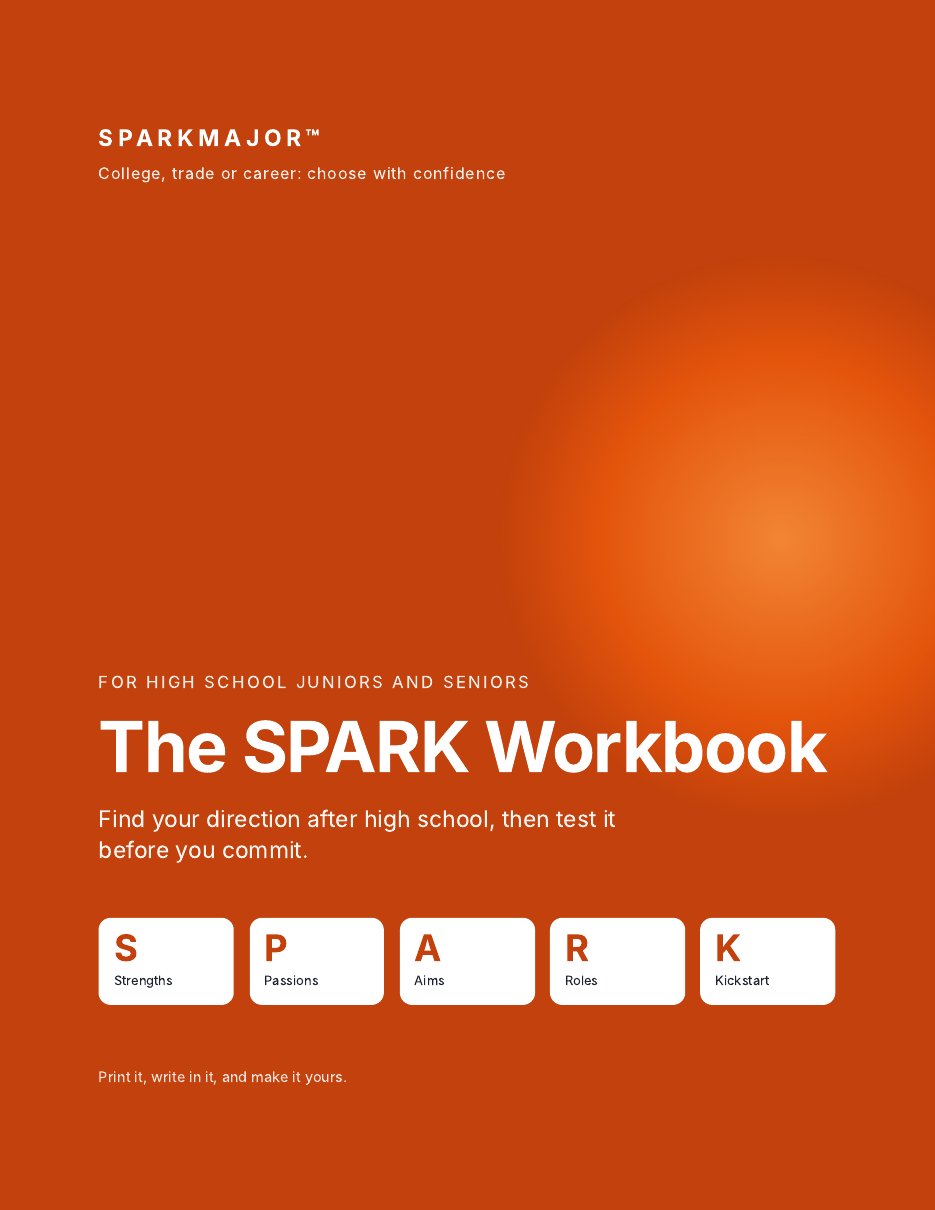
SPARK replaces guessing with five steps your teen works through at their own pace:

StepWhat your teen doesWhat they leave with
StrengthsLists what they do well and asks 3–5 people what they seeTop 5 strengths, with proof
PassionsKeeps a 7-day energy log (2 minutes a day)3 energy themes
AimsNames the problems and people they care about, ranks what they want from work, and gets honest about distance, time and costAn aim sentence and their practical limits
RolesTakes a free interest assessment and looks up every route into each match: certificate, apprenticeship, associate, bachelor's, military, on-the-job6–10 candidate paths
KickstartPicks 3 paths and tests each one: a 20-minute conversation, a job shadow, a class, an open house3 tested paths and a next move for each

That last step is the one that changes things. One afternoon with a working electrician or nurse teaches a teenager more than a month of brochures. And sometimes the most valuable result is a path they cross off before it costs a semester.

It all comes together in a one-page Direction Report your teen can bring to you, their counselor or anyone helping them decide.

Your teen tests each path in the real world before anyone pays for college, trade school or training.

Get the workbook that shows them how
🔒 Secure checkoutInstant download
What you get

Everything your teen needs to finish SPARK

Instant PDF download. Print it or work from a screen. Plan on 3–6 weeks: one week of noticing, a few 30–45 minute sittings, then a few weeks of real-world tests.

Cover of the SPARK Workbook
Two things SPARK won't do: it won't tell your teen who to be, and it won't treat college as the only respectable answer. Every route counts, and the choices stay theirs.

Who this is not for

If you want a test that tells your teen exactly what to do, this isn't it. SPARK helps them find out for themselves, which takes a few weeks of real effort. It also isn't application help, school selection or counseling for anything beyond choosing a direction. And if your teen already has a path they've tested and love, they don't need this. (Congratulations. Please tell the rest of us how.)

Why I made this

I started college planning to be a high school choir and band director, with a double major in vocal and instrumental music. One year in, I changed majors to prepare for ministry. I spent nine years as a minister and preacher. Then I changed paths again and became an air traffic controller.

Each of those choices was made in good faith. But I made them knowing about only a handful of options. Nobody showed me how many careers were out there, or how many different ways there were to get into them. I found air traffic control twelve years after high school. I might have found it much sooner.

I want my children and grandchildren to start with a wider view than I had: to know what's out there, try a few things for real, and choose from what they've seen instead of what they've heard.

That's why SPARK is built around testing instead of guessing. A conversation, a job shadow or a class costs a few hours. Finding out after a degree, or after a decade, costs a lot more.

Bruce, founder of SparkMajor™

SPARK is new. The ideas behind it aren't.

Career counselors have helped people choose their work for more than a century. The tools that hold up best all start in the same place: helping a person understand themselves before they choose. SPARK puts those tools in your teen's hands, in a form they can work through at home.

Know yourself first

Strengths, interests and values are the starting point of career counseling. SPARK has your teen gather all three, including what other people see in them.

Match interests to real work

Psychologist John Holland's six interest types have been used to match people with careers since 1959. The U.S. Department of Labor's free O*NET Interest Profiler is built on them, and SPARK uses it in the Roles step.4

Learn by trying

Informational interviews and job shadowing are long-standing tools counselors recommend. SPARK turns them into three small tests your teen can actually set up.

Why self-evaluation matters

A label from a quiz is easy to forget. A conclusion your teen reaches from their own evidence (what people told them, what gave them energy, what they saw on a job shadow) is one they believe and can explain. It's also one they can update as they grow, which matters at 16 or 17.

That's why SPARK asks questions instead of handing out answers. Your teen does the noticing, the asking and the trying. The choice stays theirs.

Source: 4. U.S. Department of Labor, O*NET Interest Profiler (My Next Move). Results from SPARK families will be added here, with their permission, as they come in.

What it costs

Get the SPARK Workbook

What's includedWhat it gives your teen
The SPARK WorkbookFive steps, one chapter each, in plain language with examples
Printable student worksheet (8 pages)A place to write it all down, ending in their Direction Report
The script packWord-for-word messages for asking for feedback, an interview or a job shadow
Every-route research guideHow to compare certificates, apprenticeships and degrees on time, cost and pay
Parents' chapter and tear-out noteWhat your role is, and what helps without taking over

For comparison: private college counselors charge an average of more than $200 an hour.3 SPARK is a one-time purchase, and your teen can come back to it anytime.

Source: 3. Independent Educational Consultants Association, State of the Profession (December 2022).

One-time payment
$27

Instant PDF download · 60-day 3 Paths Guarantee

Get the SPARK Workbook ($27)
🔒 100% secure 256-bit encrypted checkout

Add the Parent Conversation Guide or Major Test-Drive Checklist for $17 each at checkout.

Why so little? Honestly, because it's the first step, and I'd rather a thousand families have the method than fifty. Some of you will want more help later, like an app that handles the busywork or a coaching session, and those cost more. That's the self-interested part, and I'd rather say it out loud. But the workbook doesn't depend on any of it. Everything your teen needs to finish SPARK is in this download.

3 PATHS GUARANTEE MONEY BACK 60 DAYS

The 3 Paths Guarantee

If your teen works through the five steps and doesn't come away with 3 paths worth exploring, email admin@sparkmajor.com within 60 days and you'll get your $27 back. No forms and no hoops.

The method takes 3–6 weeks, so 60 days gives you plenty of room to try it properly.

The risk is mine.

I'll try it. Send me the workbook
🔒 Secure checkout60-day guarantee

Questions parents ask

My teen won't do a workbook.

Fair concern. The parts that matter most aren't writing exercises: asking people what they're good at, noticing what gives them energy, and going to see real work. The daily log takes two minutes. Most of the time is spent doing, not filling in boxes. The Parent Conversation Guide (an optional add-on at checkout) shows how to help without turning it into homework.

My teen is set on college. Is this still useful?

Yes. SPARK helps them pick a direction and a major worth testing before they declare, and the route research often turns up cheaper or faster ways into the same field.

What if they finish and still aren't sure?

"Not sure yet" is a valid result, as long as they know what they'll try next. They'll still have a clearer picture of their strengths and what to test next, and that's more than most seniors have.

Is this a career test?

No. It includes a free interest assessment, but the point is what comes after: testing real options in the real world.

Do I need the app or coaching?

No. The workbook is complete on its own.

What age is it for?

Built for juniors and seniors. Motivated sophomores do fine too.

What happens to my teen's answers?

Nothing. The workbook is a PDF your family fills in at home. We never see or collect your teen's answers.

Two ways this goes

You can close this page and things carry on as they are. The question keeps getting a shrug, the deadlines arrive anyway, and a decision gets made by default, because something had to be picked.

Or, a few weeks from now, your teen hands you a one-page Direction Report: their strengths, what energizes them, 3 paths they've actually tried, and what they want to do next. The dinner-table question gets a real answer, and it's theirs.

Your teen doesn't need to have it all figured out. They need a way to find out.

Yes, give my teen a way to find out
🔒 Secure checkoutOne-time paymentInstant PDF download60-day 3 Paths Guarantee

P.S. Most teens aren't undecided because something is wrong with them. They're undecided because they've been asked to choose without a way to test anything. The SPARK Workbook gives them five steps to find 3 paths worth exploring (college, trade or career) and a real-world test for each one. It costs $27, takes a few weeks, and comes with a 60-day guarantee. The deadlines will come either way; this way your teen meets them with a plan.